 The letter is dated October 19 1918. The salutation reads “My Dear ‘Al’.” It’s typewritten on company stationary and heartbreakingly pleading. The letter is sent from Boston Massachusetts, presumably to the front lines during World War I. The writer, William McCallum, urgently wants news about his brother, Hurlbert, who he writes was “seriously wounded in action on September 24th, 1918.” McCallum tries to piece together the story of what happened oceans away. He asks Al, “Please try to tell me where and when he was injured, how he was injured, that is, was he shot or gassed or what and if shot where he was shot, that is what part of his body.” He continues with the logistics, “Where he is now, that is, in what hospital and in what city or town?” But the underlying hurt is wrenching.
With nearly 100 years distance from the day William rolled the paper into his typewriter to pound out the letter on his keys, it would be easy to have the whole thing seem antiseptic, but it’s just not. The simplicity of his request is heartbreaking. McCallum closes his “dear Al” letter with, “Write this information to me, and not to Hurlbert’s mother.”  I found this letter among some old papers and photos my dad has saved over many years. His father was “Al” in the letter. Albert Miller, the man William McCallum hoped would reassure him with news that his brother Hurlbert was safe. He was hoping for good news to calm their mother. Why in all the things to make the journey from 1918 to today was this letter saved?
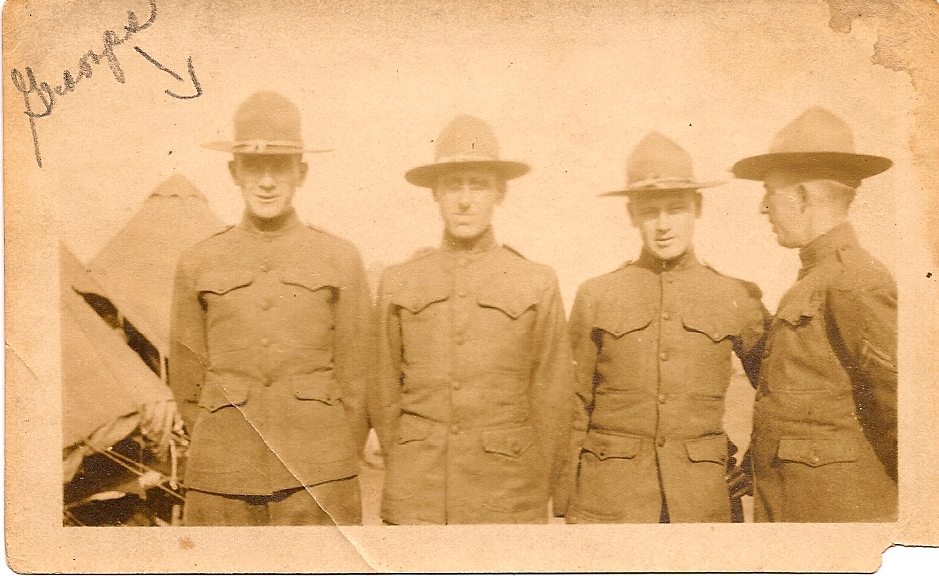
I suppose there is danger these people will become just names. However, the heartbreak, the hopes and dreams were very real in 1918. The distance of time mutes heartache, like it dulls the old photos also found in my dad’s stack of stuff. What did “Al” think when he got that letter? Was he there when Hurlbert was wounded? Among the papers and letters there is also a picture of my grandfather at that time. At about 23-years old he appears proud to be in uniform. Albert Miller as a young man smiling at me from generations away. Someone has handwritten on the photo one word, simply, “Gramps,” with an arrow pointing to him. There are four men total in the brown and beige print. Army tents in the distance.
I was just four when Albert Miller died. Other details I’m afraid will have to depend on my imagination, historical research, or my dad’s memory. While the thoughts and emotions of this young man may sadly be forgotten, we don’t want to lose the history too. In the yellowed stack of stuff there are also two little love notes, handwritten between Albert and Mildred, my grandparents. He says, “Dearest, if words could only tell how much I love you, then I too would be very happy.” It’s signed, “Always your loving, Al.” She writes to him, “Al dear, I love you truly. Your own, Mildred.” The notes aren’t dated. They hint at a very true love – strong enough that their notes became keepsakes. The couple didn’t know then, as Paul Harvey used to say, the rest of the story, of a life lived. The letters open my imagination. I know that by the mid 1930s they’ll have three children, born over a 10-year period, Joan, Albert Junior (my grandfather went by Al, my uncle went by Bert) and my dad John W. Miller. They’ll move from Queens, New York to Detroit where they’ll settle. We know of the milestones, not of the moments. Sadly, generations later I am privy to the knowledge that by the mid 1950s, Mildred Rose Miller will die of a heart attack. She’d have been about 50, or 51 — my age today. My father was a sophomore in college when his mom died. He was the last child to leave the nest. He’s told me that he got the news in a phone call while away at Michigan State. The loss he must have felt, a young man of about 19 or 20 and alone at college. Seems in the 1950’s there was no push for grief counseling or outpouring of support on social media like we see today. My dad rarely talks much about his mom’s death.
Why worry about all this? Does it matter in the scheme of things? As I type I’m actually in the midst of a class designed to help us look into the past, or as the title says we are “Writing (our) Life Stories.” I’ve got about 20 classmates also trolling through time uncovering stories, timelines, or even a better understanding of self. Doing a simple web search Yahoo.com has a list of 5 Top Reasons to research family history. They mention legacy for your kids, but also two that buzz for me, medical history and love of a good story. I think about Mildred Miller passing away, at my age, every time I pop that high blood pressure pill into my mouth. My doctor said, “Those are the genetic cards you’ve been dealt?” I have high blood pressure. Did Mildred Miller? Did she know? My maternal grandfather also had several heart attacks he was able to survive. A different kind of family history to share with my own children.
There is sadness but also magic in finding old letters like this. Stories we may never know, a complexity to life that’s lost in the ages. What will our children’s children think of us? I squirm at my keyboard to think of my grandchildren sloughing their way through my old emails trying to piece together a scrap of information about who I was. I fear that the reams of detail will be all too plentiful. No room for mystery or romantic reflections about long distance love across war zones but rather the minutiae of life in the tech age.
As for love of story,while sifting through the papers and photos in no particular order I found a torn piece of newspaper and my heart dropped. The bold type reads, “Commander McCallum’s Son Dead.” Scan further down the clip, “Hurlbert J. McCallum … died September 24th 1918 of wounds received in action.” He was already gone by the time William reached out to my grandfather Al. But nobody knew. He’d died in battle, presumably in France, a private in the infantry. I read this as if learning I’d lost a friend. One of 23-year-old Albert Miller’s friends. The emptiness his mother must have felt, not knowing for nearly a month that her child was gone. She wasn’t alone. Those were the times — mothers with their boys off fighting the Great War. The clipping does say Hurlbert had written his mom a letter in the hours before the battle that killed him. “Our greatest difficulty is the continued hard rain,” he told her, “all of us being soaked continuously.” Moments and milestones. 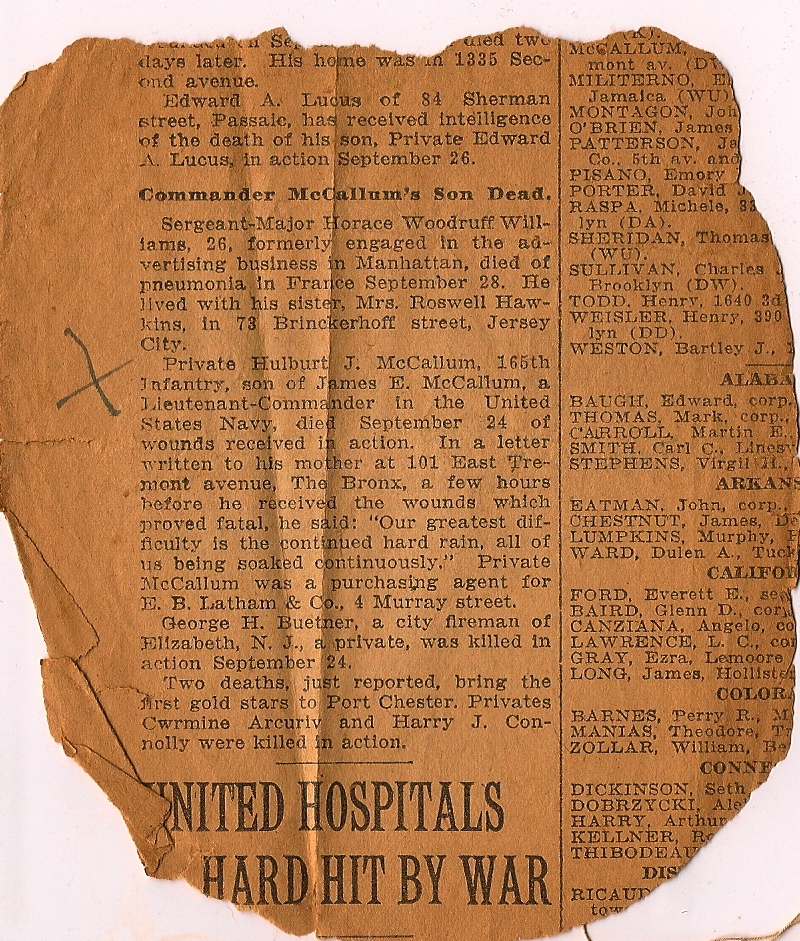

 Nancy Miller Barton